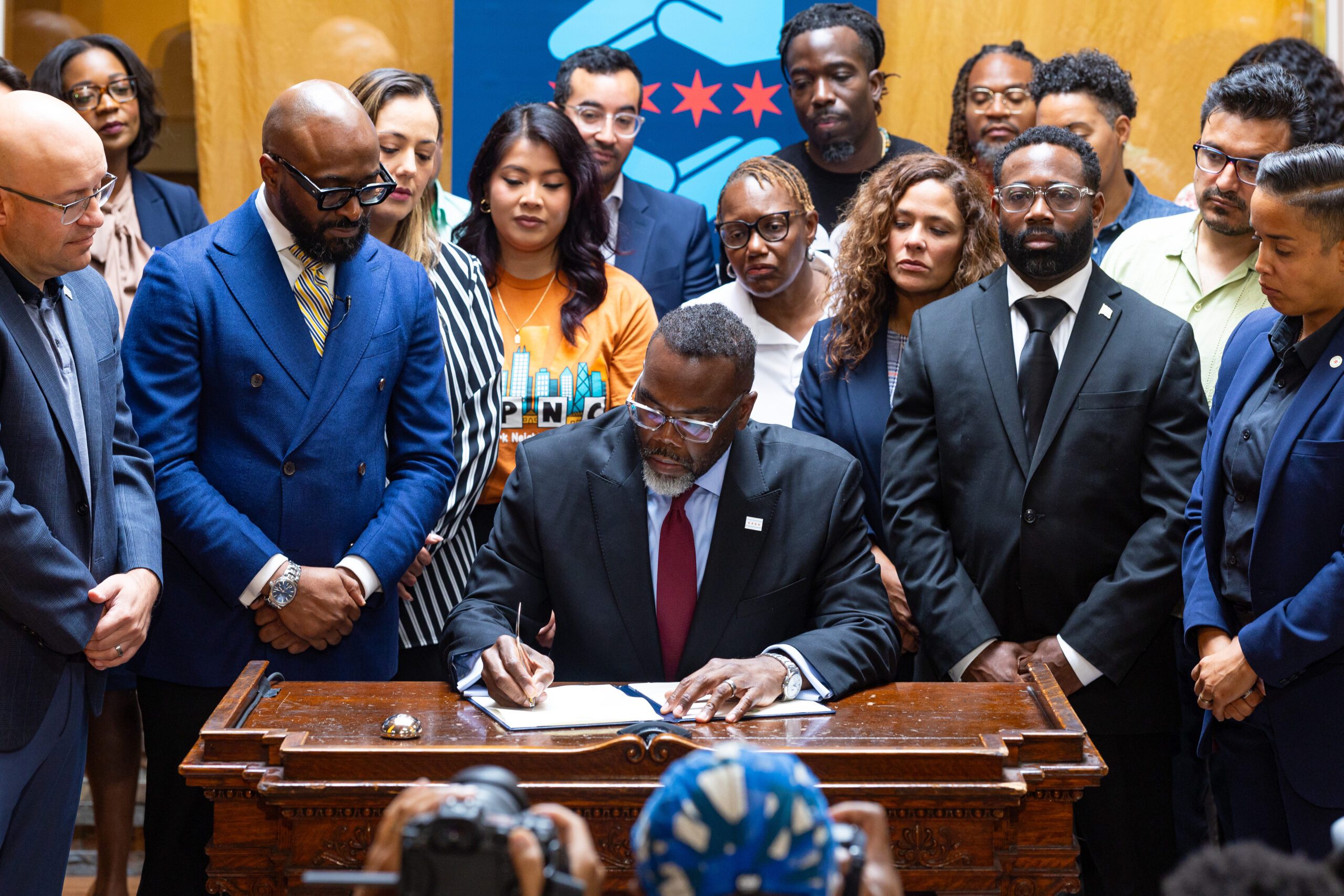
Amid heightened partisan rhetoric, claims have begun circulating from media spokespeople and politicians that remaining in the United States without permission is not a crime. Notably, former CNN host Don Lemon and Chicago Mayor Brandon Johnson have made similar inaccurate assertions that illegal immigrants are not, in fact, illegal.
The claim overlooks key distinctions between violations of federal immigration laws (civil or administrative law) and misdemeanors and felonies (criminal law).
Under the Immigration and Nationality Act, unlawful presence is either a civil violation or a criminal offense, depending on the circumstances.
For example, entering the United States without going through customs (port of entry) is a federal misdemeanor crime, under 8 U.S.C. § 1325. This crime is punishable by up to six months in prison and fines for a first offense.
Repeat offenses, i.e. attempted reentries at the border, is a felony offense with up to two years imprisonment. Illegal reentry after prior removal (deportation) under 8 U.S.C. § 1326, is also a felony offense carrying up to two years in prison, escalating to 20 years in aggravated cases.
However, partisan rhetoric has mainly conflated civil violations under administrative law – cases involving visa revocations or overstayers – for which the penalty is deportation. These cases still require ICE agents to find and arrest individuals, but within this nuance of rule violations, word games are being played.
For example, Congresswoman Hillary Scholten, D-Mich., citing an MLive article, took to X claiming that three-quarters of the 2,300 people arrested in Michigan had “no criminal record.”
“ICE made over 2,300 arrests in Michigan last year,” she wrote.”In West Michigan, nearly three-quarters of those arrested had no criminal record – directly contradicting President Trump’s stated priorities.”
The article Scholten referenced mentioned a “dad getting coffee,” and a “construction worker” just heading to the job site as proof of overreach requiring urgent Congressional “oversight, transparency, and accountability.”
Missing from Scholten’s analysis is that Tim Horton, father to four, lost his green card in 2015 after being found guilty of assault charges. While construction worker, Ernesto Cuevas Enciso, had his Deferred Action for Childhood Arrivals status overturned sometime prior to 2023 for a DUI. Both are ongoing cases, awaiting hearings.
The article also fails to mention that both individuals – knowing their status was not legal – had the opportunity to self-deport with a $1,000-$3,000 cash incentive, and would be allowed to return to the U.S. legally through the fast-tracked CBP App.
While Horton and Enciso technically committed civil or administrative violations of the Immigration and Nationality Act, administrative law is similar to contract law. In the case of immigration, that contract is with the government of the United States. When an individual applies for a green card, a visa, a work permit, or even asylum status, they enter into a lawfully binding agreement with the United States to abide by both federal laws, and the statutes or codes of their state of residence.
Even if an individual comes to the United States legally to begin with, violating the laws of the United States – committing assault or driving under the influence – constitutes a violation of that agreement.
Either way, civil violations are determined by immigration judges who then issue arrest orders for ICE agents to act upon. And, as previously reported by Deported.news, the courts have long-since upheld that an administrative process – such as an immigration hearing – legally constitutes due process.
As of late November 2025, approximately 73.6% of those in ICE custody — about 48,377 out of 65,735 — had no “criminal convictions,” as ICE does not handle criminal proceedings, only civil.
However, the invocation of the Alien Enemies Act for members of the Venezuelan gang, Tren de Aragua, in addition to the arrest of those who entered or re-entered the United States illegally, have created cross-jurisdictional delays.
For those found guilty of civil violations, deportation will likely follow. For those found guilty of criminal violations, however, they may face time in U.S. prisons prior to deportation.
While the administration prioritizes “the worst of the worst,” including those with serious criminal histories or reentry convictions, the majority of recent interior arrests target long overdue civil violators who face deportation.
While the legal framework separates civil status violations from criminal acts like murder, drug charges, unlawful entry or reentry, violations are still a crime. The only difference is the punishment.
Conflating these terms misrepresents enforcement realities: not apprehended all individuals are criminals under federal law but they’re still removable for violating immigration law, and are therefore subject to arrest and detention until the merits of their case are heard—proof of due process.
Despite these word games, and conflations of legal frameworks amid heightened and escalated rhetoric, make no mistake, the law is broken when any individual remains in the borders of the United States without permission. Arrest is guaranteed. The only difference is the punishment.