A suspected war criminal from Sierra Leone is out of America after living in the U.S. illegally for decades, signaling the U.S. will no longer harbor human rights violators.
U.S. Immigration and Customs Enforcement deported Charles Emile Mbayo, who has been linked to mass killings during Sierra Leone’s civil unrest decades earlier, from the United States to Sierra Leone on Aug. 20, according to an ICE news release.
Mbayo was a senior member of the National Provisioning Ruling Council, a military junta that seized power in Sierra Leone in April 1992. The NPRC ousted President Joseph Momoh and his All People’s Congress government.
Following the coup, the National Provisioning Ruling Council struggled to control Sierra Leone against invasion from the Revolutionary United Front. Rumors of counter-coup plots and violence spread across the capital of Freetown, according to an ICE release and Africa Briefing.
The coup coincided with Sierra Leone’s descent into a brutal civil war sparked by the invasion of Sierra Leone by rebels of the Revolutionary United Front from neighboring Liberia in 1991, according to Africa Briefing.
On Dec. 29, 1992, the National Provisioning Ruling Council killed approximately 29 victims in an effort to maintain power. Those murdered included former government officials and others accused of planning a coup against the regime. The victims were allegedly detained, tortured, executed, and their bodies buried in a mass grave, ICE officials said.
The NPRC era marked one of Sierra Leone’s most turbulent chapters, with allegations of grave human rights abuses and Mbayo linked to those events, Africa Briefing reported.
Mbayo fled his country and entered the U.S. on an F-1 student visa in 1998. He applied to become a permanent resident, but his application was denied in July 2023.
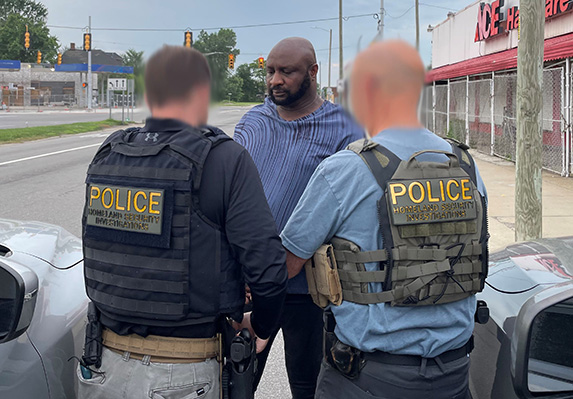
ICE Homeland Security Investigations arrested him on June 30, and he remained detained until his deportation. ICE Enforcement and Removal Operations in Detroit helped detain and remove the criminal illegal alien.
The case illustrates the Trump administration’s resolve to find and deport human rights violators, even if it’s been decades, and focus on public safety and accountability.
“Our officers continue to effect the removal of alleged human rights violators to their home country,” said ERO Detroit Field Office Director Kevin Raycraft. “ERO officers are committed to public safety and national security and removing this individual from the United States serves both those priorities.”
Jared Murphey, acting special agent in charge at HSI Detroit, noted that HSI would continue to work closely with the Human Rights Violators and War Crimes Center to investigate such cases.
“HSI is committed to ensuring that there is no safe haven in the United States for those tied to these horrific crimes,” he said.
The HSI-led Human Rights Violators and War Crimes Center assists the government in identifying, locating and prosecuting human rights abusers in the U.S., especially those suspected of participating in persecution, genocide, torture and other war crimes.
Since 2003, the Human Rights Violators and War Crimes Center has issued more than 79,000 lookouts for human rights abusers and stopped over 390 human rights violators and war crimes suspects from entering the U.S., according to ICE.
While it’s unclear whether Mbayo will face legal action upon arrival in Freetown, his deportation signifies an important step in both Sierra Leone’s search for justice and the U.S. government’s stance on human rights enforcement, Africa Briefing reported.
“For Sierra Loeone, Mbayo’s return reopens a dark chapter of its history at a time when the country continues to reckon with the legacy of its 11-year civil war,” per the article. “While the Special Court for Sierra Leone tried and convicted leaders of the RUF and allied groups, accountability for members of the NPRC has been less pronounced.”