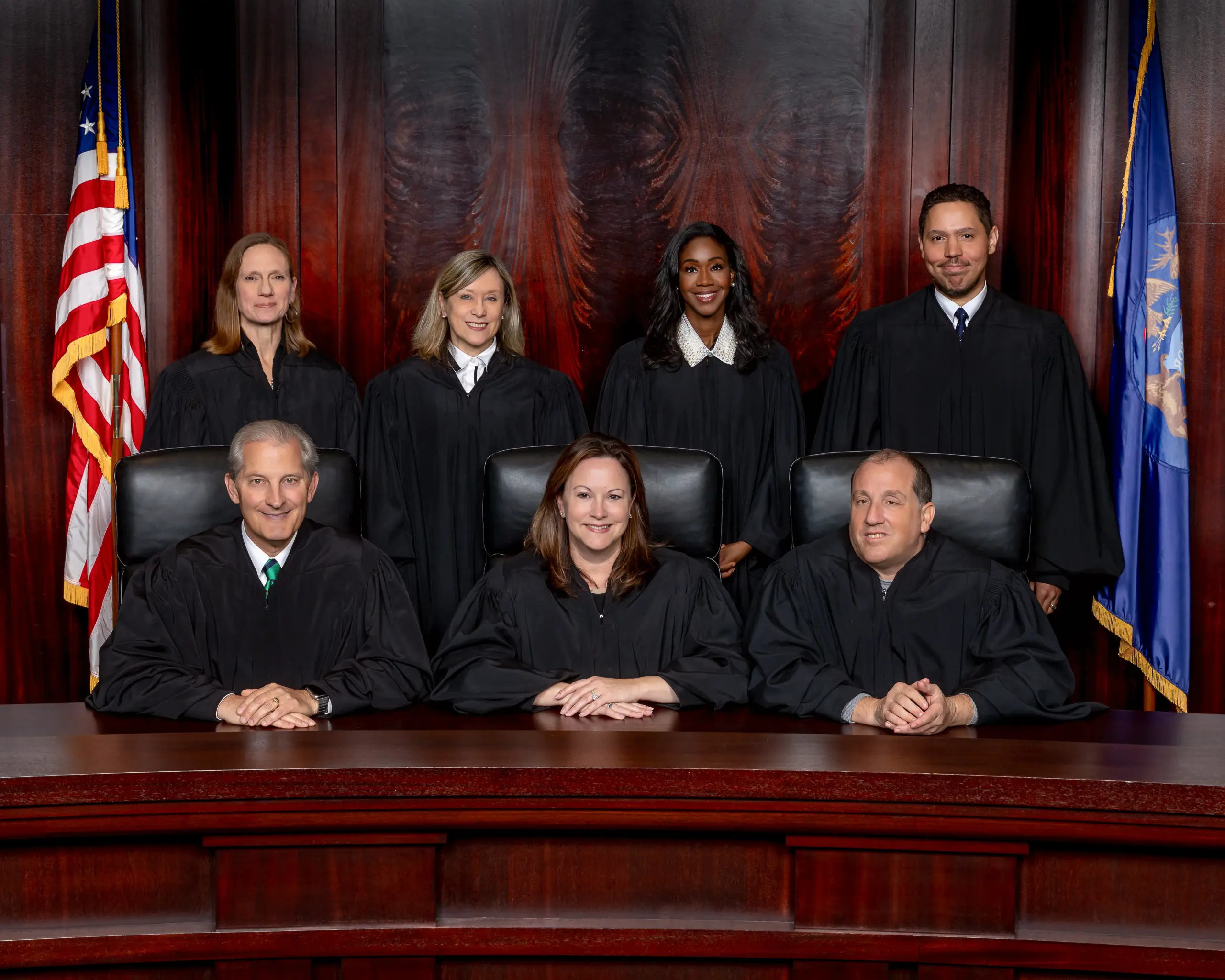
Starting Friday, Immigrations and Customs Enforcement is banned from arresting illegal immigrants at courthouses, or during “reasonable and direct travel” to and from, the Michigan Supreme Court decreed Wednesday.
“Parties, attorneys, and subpoenaed witnesses are not subject to civil arrest while going to, attending, and returning from the places they are required to attend,” the rule issued Wednesday reads. “No officer of any of the several courts of record, including jurors, shall be subject to civil arrest while going to, attending, or returning from any actual sitting of the court of which he is an officer.”
The rule, proposed in November, came at the urging of the American Civil Liberties Union, immigrant rights activists, Michigan Attorney General Dana Nessel and Democratic lawmakers, garnering about 2,500 comments during a monthlong public comment period.
Justice Brian Zahra, the only conservative on the state’s top court, described the rule as “at best a political statement framed as a solution in search of a problem,” noting only one instance of ICE arresting an illegal immigrant at court in a state with 10 million residents.
“More troublesome is that the proposed amendment will actually create problems in this state,” he wrote. “In particular, the proposal cannot be effectively enforced, and attempting to enforce the proposal will likely have an inimical result,” Zahra wrote, adding that the rule would also potentially conflict with the U.S. Constitution’s Supremacy Clause, which gives ultimate authority to the federal government.
The Michigan Sheriff’s Association also highlighted potential problems in comments to the court, noting the rule “could put Michigan law enforcement officers, tasked with providing security operations to a court in an untenable position of attempting to enforce the rule, while interfering with a federal officer in the performance of their duties.”
Zahra also noted the case of Milwaukee County Circuit Court Judge Hannah Dugan, who was convicted of felony obstruction in December for helping an illegal immigrant from Mexico evade ICE agents in her courtroom.
Dugan resigned under threats of impeachment in January after the illegal immigrant involved was arrested outside the courthouse and deported, and Dugan now faces up to 5 years in prison, The Associated Press reported.
“There is no reason to believe that a court rule, such as the one proposed here, would have deter the Department of Justice from pursing legal action against the judge, and there is no reason to believe that such a rule would protect law enforcement, judges, and staff from being convicted of obstruction under” federal law, Zahra wrote.
Michigan Immigrant Rights Center Director Susan Reed celebrated the rule in a statement that claims it “promotes full participation by noncitizens in state proceedings – that benefits all Michiganders.”
ACLU Executive Director Loren Khogali also weighed in.
“Ensuring that everyone can exercise their fundamental right to access the justice system is essential to a well-functioning democracy,” Khogali wrote in a statement. “The amended rule helps to achieve that goal.”
The change comes as Senate Democrats are pushing a proposed ban on immigration enforcement in a variety of “sensitive locations” like churches, hospitals and courthouses; ban state agencies from sharing information with ICE, and jail law enforcement officers who conceal their identity to protect their families from harassment.
While some of those bills have moved out of committee, none have received a full vote in the Senate. The legislation mirrors bills introduced in the state House and Congress that have likewise failed to gain traction.
House Speaker Matt Hall, R-Richmond Twp., has vowed to block anti-ICE bills in the lower chamber.
“The Michigan House will never pass this attack on law enforcement,” Hall said last year. “The people want these dangerous criminal aliens off our street, and we are doing everything we can to partner with the Trump administration and put an end to illegal immigration.
“Democrats will do everything they can to get in the way of local police and ICE, because they’ve always cared more about criminals than victims,” he said.
A U.S. Department of Homeland Security database documenting the “worst of the worst” criminal illegal immigrants lists 250 nabbed in Michigan during the largest deportation effort in U.S. history.
Prior convictions for those listed involve sex assaults, prostituting a minor, cocaine smuggling, DUIs, aggravated assaults, fraud, drug trafficking, hit and runs, lascivious acts with a minor, burglary, sex offenses, immigration fraud, homicide, smuggling aliens, carrying a concealed weapon, identity theft, property damage, resisting police, drug sales, racketeering, domestic violence, negligent manslaughter, flight to avoid prosecution, resisting police, amphetamine sales, cruelty toward a child, drug possession, fondling a child, possession of stolen property, counterfeiting, obstructing justice, trespassing, shoplifting, robbery, failure to register as a sex offender, prostitution, willful homicide, forceable purse snatching, probation violations, weapon trafficking, possession of burglary tools, rape, sodomy, manufacturing methamphetamines, sexual exploitation of a minor, extortion, kidnapping, computer fraud, intimidation, and other offenses.
They include illegal immigrant criminals from Honduras, Guatemala, Mexico, Israel, Cuba, Laos, Iraq, Columbia, Nigeria, China, Venezuela, Sri Lanka, Burma, Ukraine, Laos, El Salvador, Sudan, Romania, Peru, Pakistan, Ecuador, Somalia, Vietnam, Jordan, Thailand, Ghana, Poland, Cambodia, Iran, India, Spain, Pakistan, Eritrea, and Bhutan.