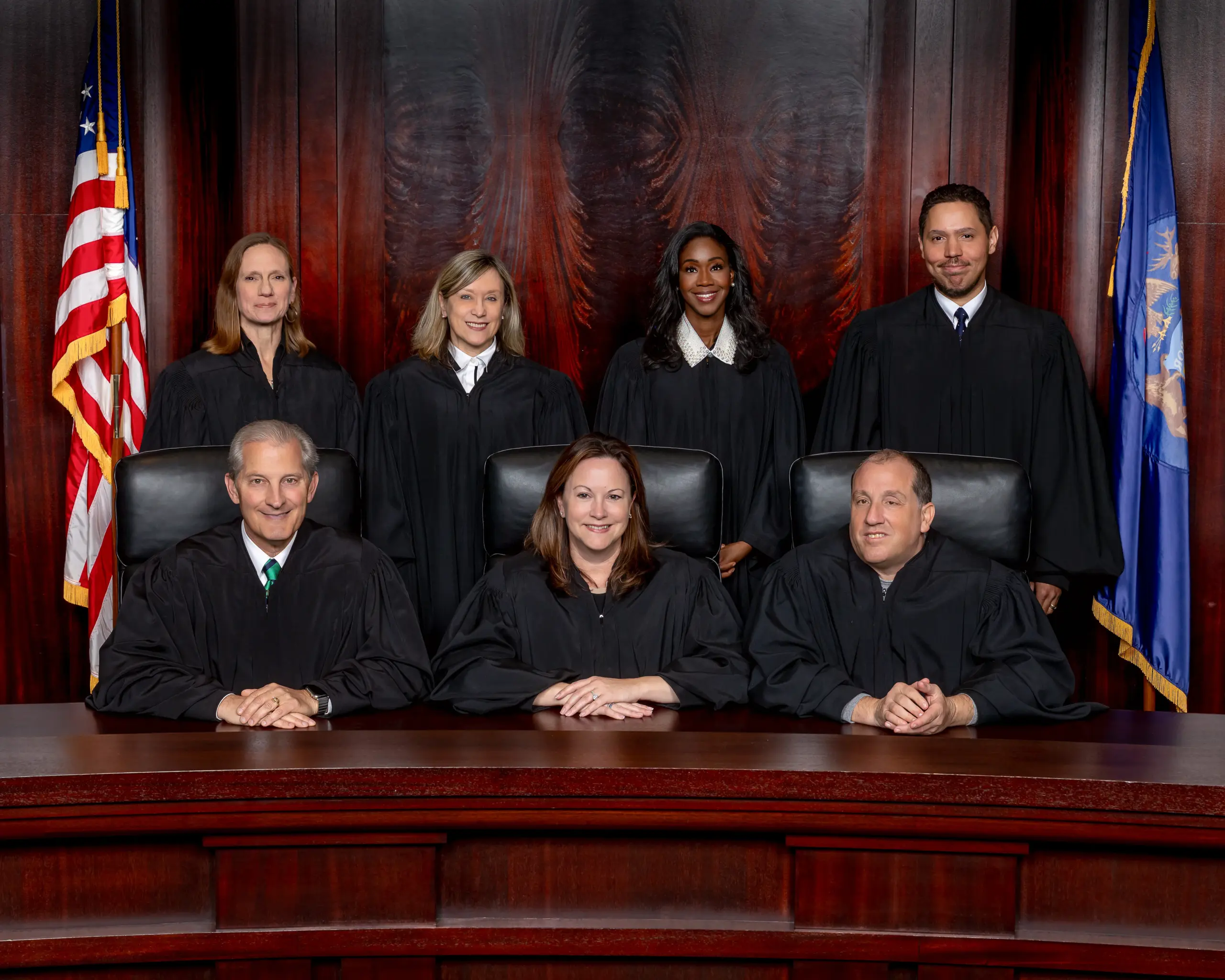
The Michigan Supreme Court is considering a rule change that would ban U.S. Immigration and Customs Enforcement from making civil arrests inside state and local courthouses.
Several Democratic-controlled states have similar policies that have faced challenges from the Trump administration. And it’s the latest legal tactic to thwart the administration’s mass deportation agenda and prevent ICE from making courthouse arrests of criminals and other illegal immigrants.
The state’s high court justices heard arguments in support of a proposed court rule that would prohibit civil arrests while a person is “attending a court proceeding or having legal business in the courthouse.”
ICE could still make arrests with a valid warrant that a judge has authorized, meaning it would not interfere with criminal or court-ordered arrest warrants.
The amendment would prevent arrests of illegal immigrants at the courthouse for other civil matters, such as showing up to traffic court, testifying in hearings or other legal business.
In an op-ed for The Detroit News, State Rep. Sarah Lightner said the Michigan Supreme Court is overstepping its role and noted that the proposed rule is “not a minor procedural change.”
“It is a significant policy shift that interferes with federal law enforcement and sends a clear political message from the bench,” Lightner wrote.
The liberal-leaning Michigan Supreme Court announced the proposed Amendment of Rule 8.115 of the Michigan Court Rules in November.
The state’s high court held a public administrative hearing on the matter Wednesday, Jan. 14.
The justices heard testimony—largely from advocates and legal professionals in favor of the change—that they will consider alongside more than 2,500 comments submitted by individuals and organizations, Bridge Michigan reported.
Six of seven current justices were appointed or nominated by Democratic governors and approved considering the amendment, while Republican-nominated Justice Brian Zahra opposed advancing the proposal for public comment, The Detroit News reported.
Opponents of the change didn’t address the court during the hearing, but several did express opposition in public commentary. They said that state courts shouldn’t interfere with federal enforcement activity, arguing that immigration law should be followed both inside and outside of courthouses.
“I do not believe the courts should be in the business of making laws from the bench,” Victoria Muterspaugh wrote in one comment submission. “Come here legally or ICE will see you to the door.”
Other write-in submissions noted the potential conflict that would be created between state and federal law if this proposal were approved.
“The proposed rule change appears to be an act of foolishness motivated by a political desire to proclaim that the State of Michigan is opposed to the federal government’s current immigration policy,” Lincoln G. Herweyer wrote, adding that “its purpose appears to be to either encourage state court judges and court staff to engage in unlawful behavior or to at least give those who obstruct federal agents in carrying out their lawful duties … the proposed change evinces the exact opposite of a policy in keeping with the rule of law.”
The court didn’t make a final ruling on the topic, and it’s not clear when they might, Bridge Michigan reported.
The amendment would apply to all state courts, which include circuit and district courts; the state Court of Claims; the state Court of Appeals; and the Michigan Supreme Court, but not federal courts.
Since states don’t have jurisdiction over what happens in immigration courts, which are federal property, they cannot bar arrests there.
The proposed amendment encompasses most arrests carried out by ICE agents, who typically rely on civil immigration warrants that are administrative, not judicial.
Michigan’s Democratic Attorney General Dana Nessel also wrote a letter in favor of the rule change. Toeing party lines, Nessel has joined other Democrat AGs in several lawsuits against the Trump administration to derail his agenda.
Nessel said the proposed amendment supports Michigan’s judicial system, ensuring courthouses and surrounding areas are safe for immigrants there on court business.
“It’s causing havoc on untold levels for us,” Nessel told Bridge Michigan in an interview. “No one’s telling ICE that they can’t continue to enforce immigration law, but please don’t do it in a way that interferes with our system of justice and our state courthouses.”
The Trump administration has challenged similar policies in other states as “sanctuary” measures that obstruct lawful arrests but been unsuccessful, Bridge Michigan reported.
The initial request for the Supreme Court review was prompted by the Michigan Immigrant Rights Center and American Civil Liberties Union of Michigan.
A January 2025 rescission of a former U.S. Department of Homeland Security policy made people afraid to appear in court, Susan Reed, a managing attorney with the Michigan Immigrant Rights Center, told The Detroit News.
The previous DHS policy, rescinded when Trump took office, prohibited ICE from conducting immigration arrests in or near courthouses except under extraordinary circumstances.
Immigration advocates and other Democratic officials maintain the fear of being arrested has disrupted many courthouse functions and hindered prosecutions, alleging that people are not showing up to pay traffic tickets, testify in hearings or conduct necessary business related to divorces, personal protection orders and landlord-tenant disputes.
“We’re really hearing from all non-citizens, even naturalized non-citizens, a lot of fear and concern around the intensity of the immigration enforcement environment,” Reed said. “We want people to be able to go to court safely and take care of their business there.”
The two groups also called on Michigan courts to change the rules around civil arrests in April, following an incident outside Plymouth’s 35th District Court.
The Detroit News reported Ramiro Sanders was mistakenly thrown to the ground and detained by federal immigration enforcement at the courthouse.
Sanders, who was released by ICE agents when they realized he was a U.S. citizen, and his wife, Laura Sanders, support the rule change “to ensure courthouses and surrounding areas are safe for immigrants there on court business.”
The Sanderses were in court accompanying a 26-year-old friend who was handling a traffic ticket. Ramiro said their friend was arrested by ICE after he left the courthouse and quickly deported to Mexico.
“People are being good citizens when they follow up and go to court. We ask them to participate in due process, and they do,” Laura Sanders told The Detroit News.
The full Michigan Supreme Court will consider the matter and comments made during the hearing and the written public comment period. No additional public hearings are planned. A written order will appear on the Michigan court website under Proposed Amendment of MCR 8.115, Planet Detroit reported.