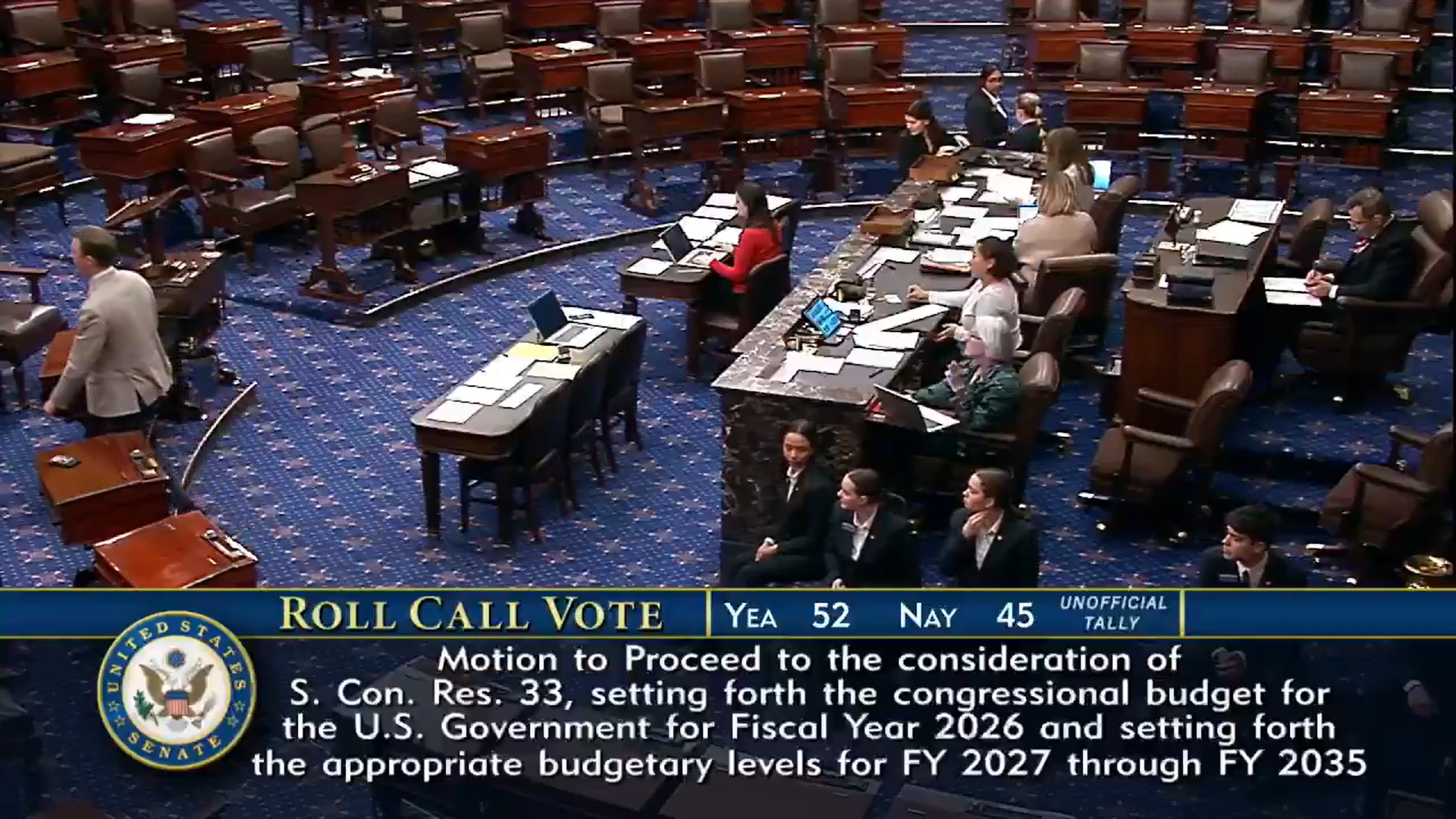
U.S. Senate Republicans on Tuesday advanced a budget resolution that paves the way for long-term funding of immigration enforcement agencies, using a procedural maneuver to bypass Democratic opposition amid a partial government shutdown now stretching more than two months.
The Senate voted 52-46 along party lines to take up the fiscal 2026 budget resolution, introduced by Senate Budget Committee Chairman Lindsey Graham, R-South Carolina. The measure provides instructions for drafting a reconciliation bill expected to deliver roughly $70 billion for U.S. Immigration and Customs Enforcement and Customs and Border Protection through the end of President Trump’s term.
🚨 JUST IN: The US Senate has just ADVANCED a MULTI-BILLION DOLLAR funding bill for DHS — fully funding ICE and CBP
This will be able to get through the Senate with just 50 votes + JD
Spare NO EXPENSE to send the illegals back! pic.twitter.com/0PeOHJAUZB
— Nick Sortor (@nicksortor) April 21, 2026
“Republicans are doing something that must be done quickly, and that our Democrat colleagues are trying to prevent us from doing,” Graham said. “That something is simple: fully fund Border Patrol and ICE at a time of great threat to the United States,” he added.
“This resolution will instruct the Judiciary and Homeland Security Committees to create a reconciliation bill that fully funds Border Patrol and ICE for 3.5 years, which will carry us through the Trump presidency,” Graham said.
Emphasizing the threat posed by more than 11 million illegal immigrants, including Islamic radicals allowed into the country under the Biden administration, Graham added: “Now is not the time to defund Border Patrol, and now is certainly not the time to put ICE out of business.”
While the resolution does not itself appropriate money, it’s the first procedural step toward producing legislation that can increase agency budgets by up to $70 billion each across the standard 10-year budget window of fiscal years 2026 through 2035.
Due to polarization, reconciliation — which requires only a simple majority vote shielded from the filibuster — has increasingly become one of the primary mechanisms for funding the federal government over the last decade. Under the Biden administration, the American Rescue Plan Act and the Inflation Reduction Act were passed through the reconciliation process—bypassing Republican opposition to open borders, the Green New Deal, and Medicare for all.
Republican leadership, calling the reconciliation strategy less than ideal, now say that Democrats have left them “with no other option.” In a floor speech addressed to President Trump, Senate Majority Leader John Thune, R-South Dakota, characterized events as Republicans bending over backward, despite a stubborn and unserious effort by Democrats to engage in bipartisan negotiations.
“Democrats refused to fund the deportation of criminal illegal aliens – individuals guilty of things like murder, assault, and sexual crimes against minors,” Senate Majority Leader John Thune said while delivering a speech on the Senate floor.
“They refused to fund drug interdiction and efforts to fight human trafficking.
“They refused to fund border security.
“That’s right.
“They refused to fund the Border Patrol.
“These are all critical security priorities.
“And so, Mr. President, Republicans are going to fund them through reconciliation because the Democrats have left us no other option.
“And to prevent Democrats from voting to defund law enforcement once again in September, we’re going to fund border security and immigration enforcement for the next three years.”
A separate Senate-passed bill already funds the rest of the Department of Homeland Security, including TSA, FEMA and the Coast Guard, but House Republicans have refused to act on it without resolution of the ICE and Border Patrol piece.
Committees have until around mid-May to mark up their portions. The full reconciliation bill, which GOP leaders hope to keep narrow, could reach the Senate floor for a “vote-a-rama” of amendments soon after.
President Trump has set a June 1 deadline for the measure to reach his desk. The approach reflects Republican priorities on border security while navigating narrow majorities and the ongoing shutdown, now the longest in history for parts of DHS. Details of the final bill, including exact funding levels and any policy provisions, will be fleshed out in coming weeks.