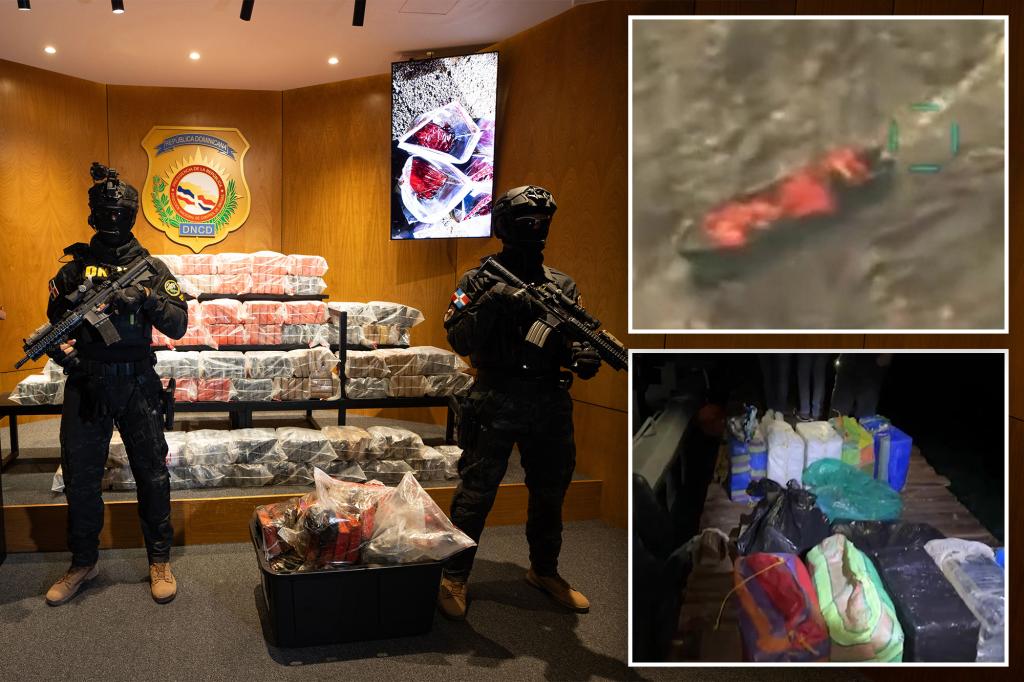
The third suspected drug smuggling boat struck by the United States last week was carrying more than a ton of cocaine, according to Dominican Republic officials who recovered some of the drugs.
The U.S. military blew up a third drug trafficking boat Sept. 19 in the Caribbean Sea, south of the Dominican Republic, in the U.S. Southern Command’s area of responsibility, BBC reported. The attack killed three male narcoterrorists on board and had the support of Dominican Republic officials.
Dominican Republic says it seized 377 packages of cocaine on speedboat destroyed by US Navy https://t.co/53lKRJM2vB pic.twitter.com/LU6PTH1ibh
— New York Post (@nypost) September 22, 2025
President Donald Trump said he ordered the latest “lethal kinetic strike” against alleged narco-terrorists after U.S. intelligence confirmed it was trafficking drugs. The strike is part of a broader effort to combat international drug trafficking and support homeland security efforts.
Officials said the speedboat was loaded with narcotics and heading to Dominican territory. The cocaine was ultimately bound for the United States.
Trump announced the strike on Truth Social and said it happened in international waters. No U.S. forces were harmed in the attack.
“Intelligence confirmed the vessel was trafficking illicit narcotics, and was transiting along a known narcotrafficking passage enroute to poison Americans,” Trump said.
Trump’s post featured a video showing the boat travelling on a body of water, and seconds later it explodes and bursts into flames.
“STOP SELLING FENTANYL, NARCOTICS, AND ILLEGAL DRUGS IN AMERICA, AND COMMITTING VIOLENCE AND TERRORISM AGAINST AMERICANS!!!” he warned.
Trump did not say which terrorist organization was targeted or where the vessel originated from, the New York Post reported.
The Dominican Republic later confirmed the strike and said the boat had been ferrying “approximately 1,000 kilograms of suspected cocaine,” Fox News Digital reported. It was the first “joint operation against narcoterrorism in the Caribbean region” between the Dominican Republic and the U.S., according to the release about the effort.
The country’s National Drug Control Directorate and its navy seized hundreds of packages of the drug after the U.S. airstrike. “The packages were sent, under chain of custody, to the National Institute of Forensic Sciences (INACIF) to determine their exact type and weight,” the country noted.
With the southern border essentially shut down, the Trump administration has taken the fight against drug cartels to international waterways. The U.S. Department of War has deployed several ships to the Caribbean to counter transnational drug shipments.
The U.S. Coast Guard and Navy launched Operation Pacific Viper on Aug. 8, and the effort has seized over 75,000 pounds of illegal drugs so far. The offshore operation sent a surge of resources to the Eastern Pacific to cut off drugs and human smuggling before it reaches American shores.
Trump is also after Venezuelan dictator Nicolás Maduro’s corrupt regime, believed to be behind much of the drug trafficking out of Venezuela. Trump’s Department of State has placed a $50 million bounty on Maduro’s head for violating U.S. narcotics laws.
Trump ordered the first military airstrike on a suspected drug boat on Sept. 2, targeting alleged drug-smuggling terrorists operating under the control of Maduro’s regime.
The blast destroyed the boat, believed to be carrying narcotics, as the boat traveled in open waters. U.S. officials said they killed 11 suspected members of Tren de Aragua.
The second U.S. strike against Venezuela-based drug traffickers took place on Sept. 15, killing three “male terrorists” aboard a boat attempting to smuggle narcotics, the New York Post reported.
In February, the Trump administration also designated drug cartel groups like Tren de Aragua, the Sinaloa Cartel and others as foreign terrorist organizations.
Trump officials have prioritized the deportation of illegal TdA members in an effort to make America safe again.
The U.S. Department of Homeland Security has sought to end Biden-era parole programs and Temporary Protected Status for Venezuelans currently protected from deportation, citing national security concerns, but been met with multiple lawsuits.
Operation Pacific Viper was ordered by President Trump to combat foreign drug cartels in Latin America. The U.S. Coast Guard, which usually heads up narcotics enforcement at sea, is doing its part to stop the maritime trafficking of drugs as part of the larger border security effort.
On Sept. 10, Coast Guard members intercepted an alleged cartel semi-submersible in a Pacific Viper operation. The water-based bust was caught on camera and aired by news outlets, showing members aboard the Coast Guard Cutter Seneca boarding a suspected drug boat. They interdicted 5,500 pounds of cocaine northeast of the Galápagos Islands.
The Eastern Pacific Ocean is where significant transport of illicit narcotics continues from South America. The Coast Guard is averaging over 1,800 pounds of illegal drugs interdicted per day, per a news release.
The drug seizures, and the apprehension of 59 individuals suspected of narco-trafficking, were the result of more than 20 interdictions since Aug. 8.
“The Coast Guard is bringing every authority and every capability at our disposal to disrupt cartels and criminal organizations, stop the flow of deadly drugs into the U.S., and secure U.S. borders and maritime approaches,” said Rear Adm. Jeffrey Novak, deputy commander Pacific Area. “While we continue our crucial work to defend America, I could not be prouder of the men and women of the Coast Guard in celebrating this milestone.”
Detecting and interdicting narco-terrorism on the high seas involves significant interagency and international coordination, the Coast Guard said. U.S. Southern Command’s Joint Interagency Task Force-South, based in Key West, Florida, detects and monitors both aerial and maritime transit of illegal drugs.
The Department of War recently added a guided-missile destroyer, USS Stockdale, to the fleet in the Caribbean Sea. This makes eight U.S. Navy surface warships and one nuclear-powered submarine operating as part of the Trump Administration’s homeland security efforts, USNI News, a nonprofit news service covering the U.S. Navy, reported.
Trump’s tactics to destroy suspected drug-smuggling boats has drawn criticism. Legal experts previously told the BBC that the fatal strike on the first vessel in international waters may have violated international human rights and maritime law.
Narcotics enforcement typically falls to the U.S. Coast Guard, which is the United States’ lead federal agency for maritime drug interdiction. But these larger military ships are often with embarked Coast Guard law enforcement detachments, USNI reported.
In late August, the Coast Guard achieved its largest-ever drug seizure in a single operation as part of Operation Pacific Viper. The U.S. Coast Guard Cutter Hamilton offloaded over 75,000 pounds of illegal drugs, valued at $473 million, at Port Everglades, Florida, DHS said in a news release.
The drugs included approximately 61,740 pounds of cocaine and approximately 14,400 pounds of marijuana.
“The crew of Hamilton, who have been on the ship for over the last two months, personally interdicted over 47,000 pounds cocaine,” said Rear Adm. Adam Chamie, Coast Guard Southeast District Commander. “These men and women put themselves in harm’s way time and again to stop the bad guys, apprehend the smugglers and seize the drugs. This is grueling and dangerous work, and I am extremely proud of them.”