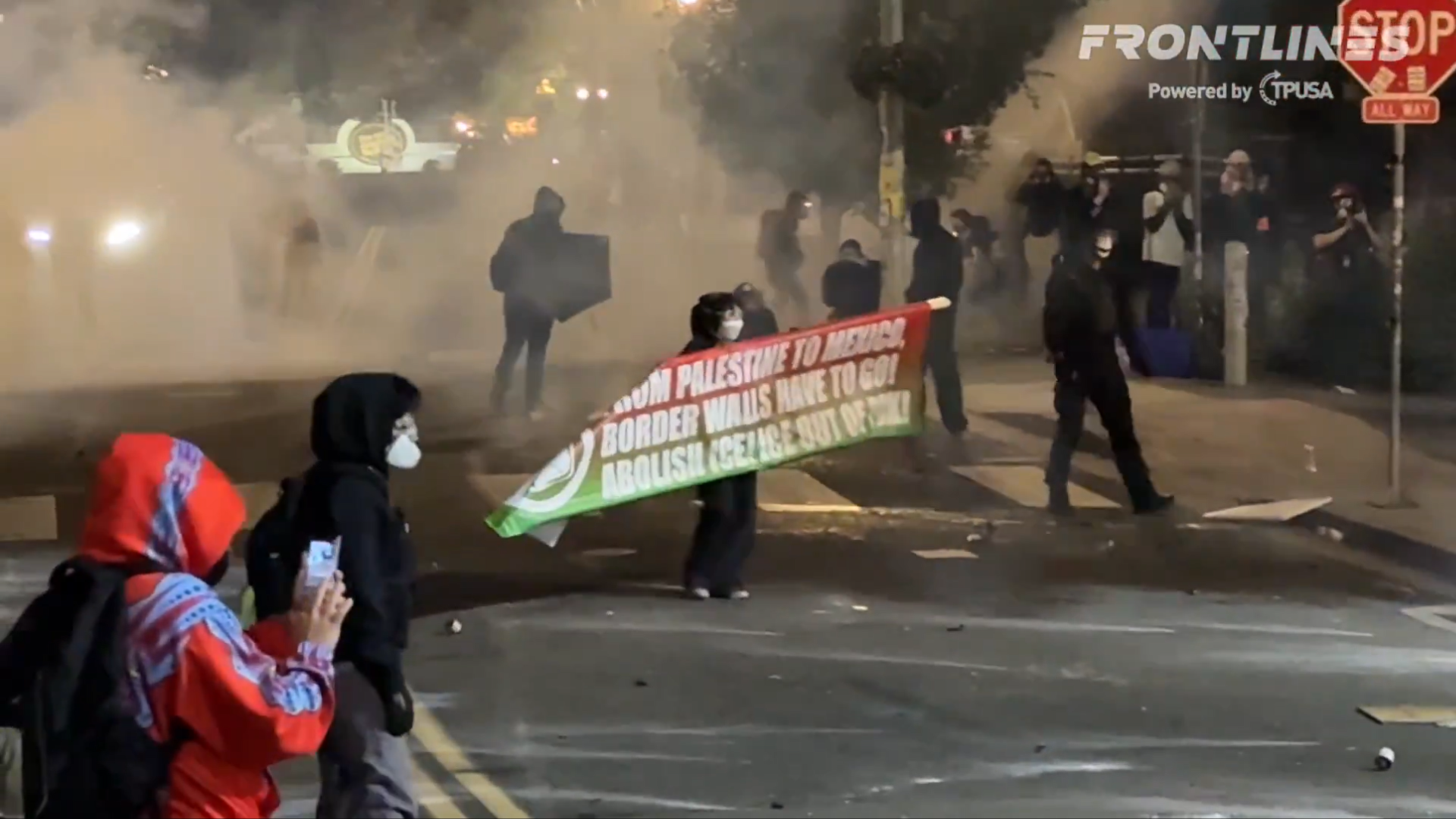
After nearly five months of daily protests outside the immigration facility in Portland, Ore., the Trump administration has the green light to deploy National Guard troops into the city for now.
On Monday, the 9th U.S. Circuit Court of Appeals ruled 2-1 that President Donald Trump can use the National Guard to protect federal assets, personnel, and public safety in Portland until the state’s case moves through the courts.
“We conclude that it is likely that the President lawfully exercised his statutory authority under 10 U.S.C. § 12406(3), which authorizes the federalization of the National Guard when ‘the President is unable with the regular forces to execute the laws of the United States,’” the majority wrote.
The ruling overrides a lower court’s order that blocked the deployment. And it comes after a weekend of “No Kings 2.0” protests that ignited another round of clashes between protestors and federal agents outside of Portland’s ICE facility. This scene has unfolded almost daily since June.
Hundreds of protesters headed to the Portland ICE building after the daytime protests, according to local KPTV FOX 12 and News Nation reports, which led to federal agents using tear gas, pepper balls, and flashbangs to break up the crowds. Portland Police Bureau reported three arrests.
Trump issued the order to send the National Guard to the city on Sept. 27, announcing it on his Truth Social platform, but it was immediately challenged by a lawsuit filed on behalf of state and local city officials. They also filed a restraining order to keep the troops out of the city.
Monday’s appeals court decision granted the Justice Department’s request to lift a judge’s order that had temporarily blocked the deployment while the lawsuit plays out.
“Another VICTORY for President Trump and the safety and security of the American people,” U.S. Department of Homeland Security Secretary Kristi Noem shared on X. “The law, U.S. Constitution, and supremacy clause back the President’s action to protect the public and law enforcement, and today this ruling has vindicated us.”
Another VICTORY for President Trump and the safety and security of the American people.
The U.S. Circuit Court of Appeals for the Ninth Circuit ruled that @POTUS is rightfully using his Constitutional authority to direct the National Guard to protect federal assets, personnel…— Secretary Kristi Noem (@Sec_Noem) October 20, 2025
The three-member appeals panel ruled 2-1 to authorize Trump’s deployment. The court agreed that National Guard deployment was an “appropriate response” to protesters, who have threatened and attacked U.S. Immigration and Customs Enforcement officers, local residents and independent journalists.
Democratic leaders in the sanctuary state and city claim everything is fine in Portland, while allowing protests, homelessness and drug use to fester. Their lawsuit argues that Trump has exaggerated the protests, describing the city as “war ravaged” with “ICE Facilities under siege from attack by Antifa.”
They claim Trump’s order is a power grab to illegally take control of state National Guard units—a move that is not wanted or needed.
But footage from numerous independent journalists and pleas from local residents who live near the ICE facility paint a different picture. A resident, Cloud Elvengrail, even sued the city for not enforcing the noise ordinance.
Since June, anti-ICE activists and Antifa agitators have created problems and disrupted daily life for residents living near the ICE facility. They have set up an encampment, yelled into bullhorns late into the night and damaged federal property.
Two Trump-appointees, Circuit Judge Ryan Nelson and Circuit Judge Bridget Bade, sided with Trump’s decision to call up the guard, Fox News Digital reported.
“It may well be that the forces are used in an improper way, but we don’t have evidence of that,” Nelson said during oral arguments, adding that it “doesn’t strike me as a glaring overuse on its face.”
Circuit Judge Susan Graber, an appointee of Democratic President Bill Clinton, dissented. She called the ruling “not merely absurd,” but dangerous, Reuters reported.
Oregon Assistant Attorney General Stacy Chaffin argued the protests are not a “rebellion” — one of two conditions Trump needs to meet for National Guard deployment.
The Trump administration praised the ruling, saying Trump had exercised his lawful authority to protect federal assets and personnel from protesters.
Democrats have increasingly turned to the courts to stop the Trump administration on multiple fronts, particularly around immigration and crime crackdowns in Democratic-led cities. The courts have issued mixed rulings over Trump’s use of the National Guard in other states such as California and Illinois.
Trump has asked the U.S. Supreme Court to weigh his authority to send troops to sanctuary cities including Chicago. Last week, a three-judge panel of the Chicago-based 7th U.S. Circuit Court of Appeals ruled that a temporary restraining order could remain in place, Reuters reported.
On Monday, attorneys for Illinois asked the U.S. Supreme Court to reject a request for an emergency appeal filed by the Trump administration to allow the immediate deployment of 700 National Guard troops into Chicago.
The legal saga in Portland began earlier this month when Portland-based U.S. District Judge Karin Immergut blocked Trump from sending any Guard troops to Portland.
Immergut, who is also a Trump appointee, issued similar decisions against the administration in two emergency rulings on Oct. 4 and 5. She first barred Trump from activating Oregon’s National Guard and then ruled that he could not circumvent that decision by calling in National Guard troops from other states.
In her order, Immergut said that Trump likely acted unlawfully when he ordered troops to Portland, agreeing with the state’s Attorney General that recent protests in Portland didn’t amount to a “rebellion.” She scheduled a non-jury trial set to begin on Oct. 29 to rule on a longer-term block, Reuters reported.
Immergut is one of three district court judges who have ruled against Trump’s use of the National Guard, and no district court judge has yet ruled for Trump in the National Guard cases, Reuters reported.