The Trump administration’s full-court press to get immigration under control continues with a pause on immigrant visa applications from 75 countries.
The U.S. Department of State announced the latest measures to restrict applicants deemed likely to become a public charge upon arrival or to need extended government assistance.
The visa processing pause takes effect on Jan. 21 and will continue indefinitely until the department conducts a reassessment of immigrant visa processing. The freeze applies to 75 countries, including Somalia, Russia, Iran, Afghanistan, Brazil, Egypt and Nigeria, among others.
The measure falls under the public charge provision, which has existed for decades. But enforcement varies across administrations, with consular officers historically given broad discretion in applying the standard.
The State Department confirmed the news Wednesday, posting on X that the pause applies to 75 countries whose migrants take “welfare from the American people at unacceptable rates.”
The State Department will pause immigrant visa processing from 75 countries whose migrants take welfare from the American people at unacceptable rates. The freeze will remain active until the U.S. can ensure that new immigrants will not extract wealth from the American people.
— Department of State (@StateDept) January 14, 2026
The freeze will remain active until the U.S. can ensure that new immigrants will not extract wealth from the American people, according to department officials.
The Department of State continued on social media: “The pause impacts dozens of countries — including Somalia, Haiti, Iran, and Eritrea — whose immigrants often become public charges on the United States upon arrival. We are working to ensure the generosity of the American people will no longer be abused.”
The pause impacts dozens of countries – including Somalia, Haiti, Iran, and Eritrea – whose immigrants often become public charges on the United States upon arrival.
We are working to ensure the generosity of the American people will no longer be abused.
— Department of State (@StateDept) January 14, 2026
The crackdown revives and expands a Trump-era standard officials say was relaxed under President Joe Biden, Fox News Digital reported.
The Immigration and Nationality Act has long allowed consular officers to deem applicants inadmissible on public charge grounds. President Donald Trump in 2019 expanded the definition to include a broader range of public benefits.
Trump’s expansion was challenged in court, with portions ultimately blocked before being rescinded by the Biden administration.
In another report from November, FOX obtained a State Department memo regarding the matter. The cable directed U.S. embassies worldwide to enforce sweeping new visa screening rules under the so-called “public charge” provision of immigration law.
The memo instructed consular officers to deny visas to applicants deemed likely to rely on public benefits, considering various factors including health, age, English proficiency, finances and even potential need for long-term medical care.
“Self-sufficiency has been a longstanding principle of U.S. immigration policy,” the cable that went out to U.S. consular officers across the globe states, “and the public charge ground of inadmissibility has been a part of our immigration law for more than 100 years.”
Exceptions to the new pause will be “very limited” and only allowed after an applicant has cleared public charge considerations, Fox reported.
The freeze comes amid a massive welfare fraud scandal involving the Somali immigrant community in Minnesota and other states.
In more startling revelations, Transportation Security Administration agents detected nearly $700 million in cash in luggage leaving the Minneapolis-St. Paul International Airport in 2024 and 2025, apparently bound for Somalia.
The Minnesota welfare fraud related to housing and nutritional programs dates back several years and has led to nearly 100 people being charged, mostly from the Somali community.
But additional allegations blew up in recent weeks after two viral videos by YouTuber Nick Shirley. The latest investigation involves sham businesses that are supposed to be Somali-owned day cares, home health care companies, and non-emergency transportation companies.
In another move this week, the Trump administration revoked Somalia’s Temporary Protected Status. The impacted Somalis with TPS have until March 17 to leave the country.
Sources at U.S. Citizenship and Immigration Services told Fox News Digital that there are 2,471 Somali nationals currently in the U.S. under TPS, with 1,383 in the country with pending TPS applications. An estimated 600 Somali nationals who are protected by TPS live in Minnesota, Fox News Digital reported.
Homeland Security Secretary Kristi Noem explained that “allowing Somali nationals to remain temporarily in the United States is contrary to our national interests.”
“Temporary means temporary,” Noem added. “Country conditions in Somalia have improved to the point that it no longer meets the law’s requirement for Temporary Protected Status.”
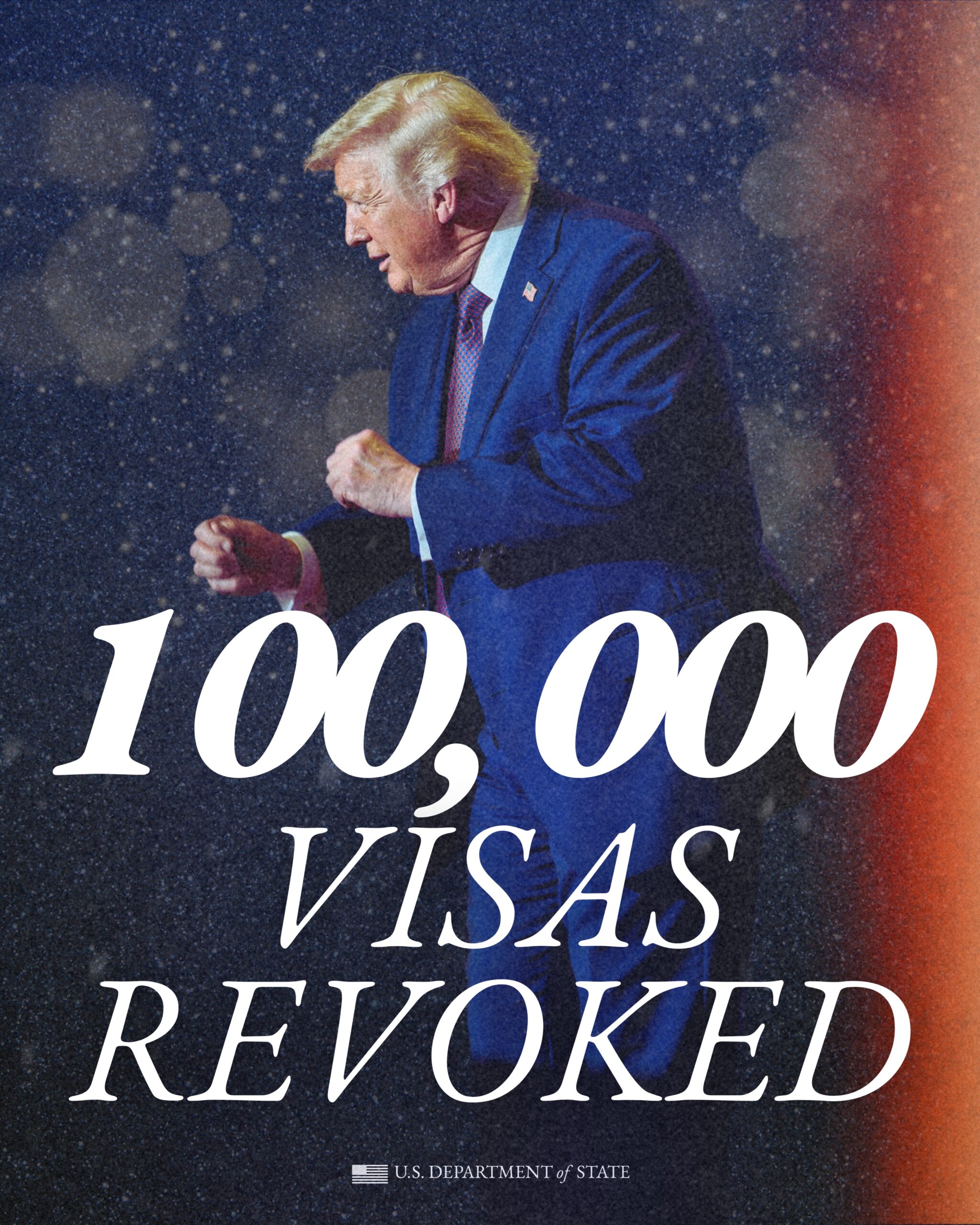
The State Department also said it revoked more than 100,000 visas from foreign nationals in 2025. The number represents more than 150% of an increase from 2024, and includes 8,000 student visas and 2,500 specialized visas.
The Department of State said in a post on X this week that the visas were revoked from individuals who had encounters with U.S. law enforcement for criminal activity.
🚨BREAKING: The State Department has now revoked over 100,000 visas, including some 8,000 student visas and 2,500 specialized visas for individuals who had encounters with U.S. law enforcement for criminal activity.
We will continue to deport these thugs to keep America safe. pic.twitter.com/wuHVltw1bV
— Department of State (@StateDept) January 12, 2026
“We will continue to deport these thugs to keep America safe,” the Department shared with a photo of President Trump and “100,000 Visas Revoked.”
During a press conference on Dec. 28, 2025, Secretary of State Marco Rubio defended the visa revocations, The Epoch Times reported. The U.S. has the right to restrict who is allowed into the country and who can stay.
“There are people that have visas, that are in the United States, doing things counter to our national interest, and the law gives us the right, and I would argue the obligation, to remove people like that from our country, and we’re going to continue to do it,” he said.
“If you have the power to deny someone a visa before they get one, you most certainly have the power to revoke it once they get one and then do something they shouldn’t be doing.”
The countries affected by the visa freeze are Afghanistan, Albania, Algeria, Antigua and Barbuda, Armenia, Azerbaijan, Bahamas, Bangladesh, Barbados, Belarus, Belize, Bhutan, Bosnia, Brazil, Burma, Cambodia, Cameroon, Cape Verde, Colombia, Congo, Cote d’Ivoire, Cuba, Dominica, Egypt, Eritrea, Ethiopia, Fiji, Gambia, Georgia, Ghana, Grenada, Guatemala, Guinea, Haiti, Iran, Iraq, Jamaica, Jordan, Kazakhstan, Kosovo, Kuwait, Kyrgyzstan, Laos, Lebanon, Liberia, Libya, Macedonia, Moldova, Mongolia, Montenegro, Morocco, Nepal, Nicaragua, Nigeria, Pakistan, Republic of the Congo, Russia, Rwanda, Saint Kitts and Nevis, Saint Lucia, Saint Vincent and the Grenadines, Senegal, Sierra Leone, Somalia, South Sudan, Sudan, Syria, Tanzania, Thailand, Togo, Tunisia, Uganda, Uruguay, Uzbekistan, and Yemen.