Democratic State Attorneys General are claiming victory in a multistate lawsuit against the Trump administration over its attempt to withhold billions in federal funding for emergency services if states did not cooperate in immigration enforcement.
The District Court for the District of Rhode Island granted a motion for summary judgment on Wednesday, siding with 20 attorneys general in their lawsuit against the Federal Emergency Management Agency and the U.S. Department of Homeland Security.
The AGs filed two separate lawsuits against the Trump administration in May. The first was against FEMA and DHS. The coalition filed a second lawsuit against the Department of Transportation (DOT) and DOT Secretary Sean Duffy.
The lawsuits were in response to an executive order issued by President Donald Trump directing the U.S. Department of Homeland Security to “ensure that so-called ‘sanctuary’ jurisdictions do not receive access to federal funds.”
In its 45-page ruling, the Rhode Island District Court held that the agencies violated the Constitution and the Administrative Procedure Act by conditioning federal funds from FEMA and DHS on states’ agreement to assist in enforcing federal immigration law.
Senior District Judge William Smith also granted a permanent injunction prohibiting DHS from enforcing the contested conditions against plaintiff states. The judge ruled it is “appropriate” since they stand to suffer “irreparable harm.”
“The Court finds that the contested conditions are arbitrary and capricious and thus invalid under the APA and are also a violation of the conditions attached to the Spending Clause and thus unconstitutional,” Smith wrote in the ruling.
In its lawsuit Democratic AGs accused the administration of trying to “illegally coerce states into assisting in sweeping immigration enforcement.”
Trump officials threatened to withhold billions in federal funding for emergency preparedness and preventing and addressing terrorist attacks, mass shootings, wildfires, floods, cybersecurity threats and more.
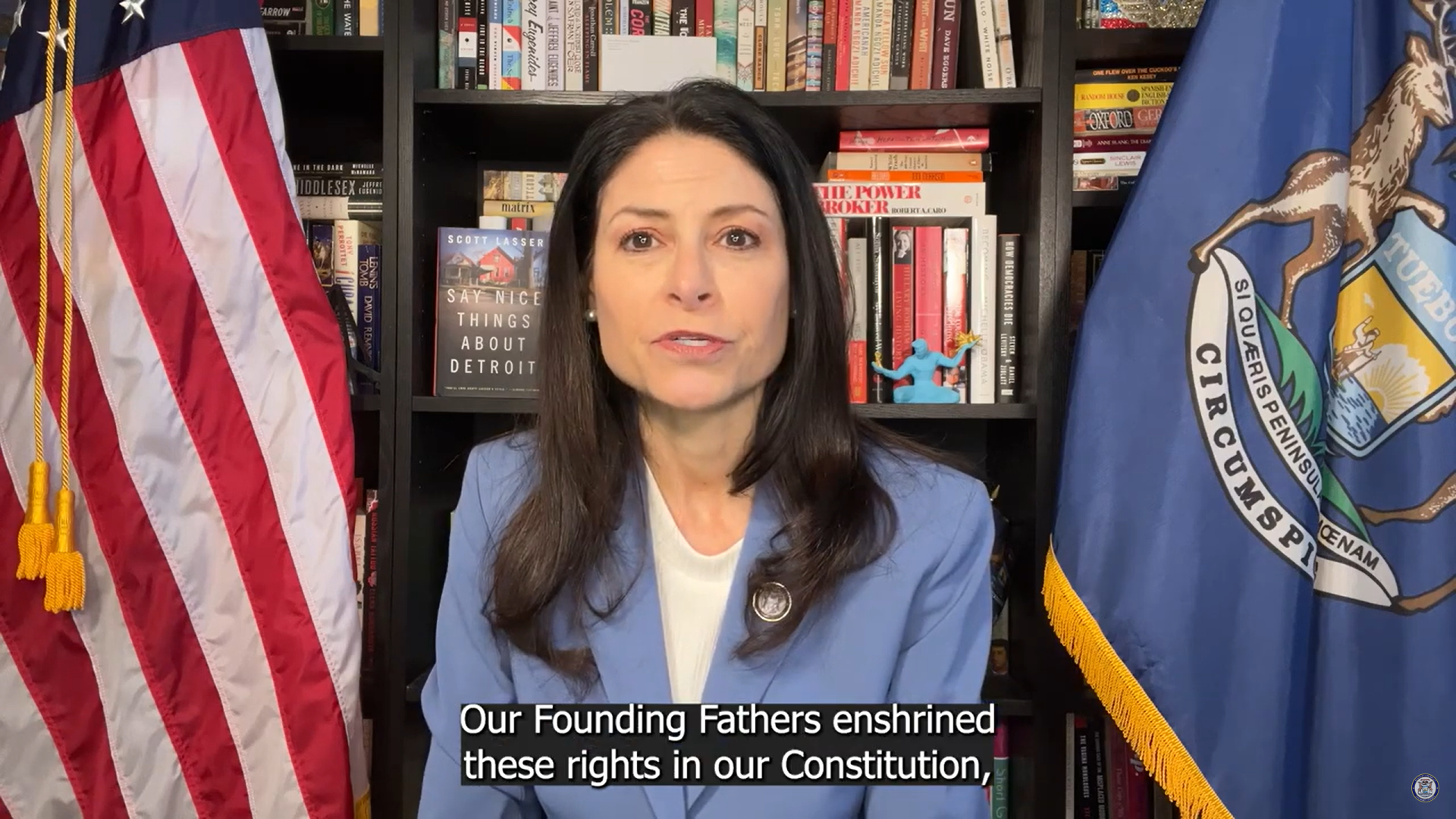
“This ruling makes clear that no administration can hold appropriated federal funds hostage to advance a political agenda,” Nessel said in a statement. “Michigan residents deserve to know the public safety resources their tax dollars support will be there to protect them when disasters strike.”
In February, Homeland Security Secretary Kristi Noem directed DHS and its sub-agencies, including FEMA, to stop federal funding to jurisdictions that do not assist the federal government in the enforcement of federal immigration law.
In March, DHS amended the terms and conditions it places on all federal funds to require recipients to certify that they will assist in enforcing federal immigration law.
The AGs teamed up to file the lawsuit and push back against the “sweeping new conditions.” They argued it was unconstitutional and illegal, saying the federal government could not put conditions on funding for emergency services.
The new rules would have require states and state agencies to cooperate with federal immigration enforcement efforts or lose out on billions of federal dollars that states use to protect public safety.
In the decision, the Court agreed that DHS violated the Administrative Procedure Act in adding the conditions because the agency engaged in a “wholly under-reasoned and arbitrary process.”
DHS also failed to consider public safety consequences for the states, and made the conditions “vague and confusing…making compliance a nearly impossible-to-achieve moving target,” the judge wrote.
The conditions left states to “guess at what conduct satisfies the requirements” under threat of losing billions in essential funding, the court ruled.
The court further held that the conditions violate the Constitution’s Spending Clause. The court rejected DHS’ argument that placing immigration-related conditions on the grant funding was appropriate simply because many of the grants are designed to prevent and respond to acts of terrorism.
“The Spending Clause requires that conditions be ‘reasonably calculated’ to advance the purposes for which funds are expended, Dole, 483 U.S. at 209, and DHS has failed to demonstrate any such connection outside of a few programs like Operation Stonegarden,” the court ruled. “The Court therefore concludes that the conditions are overbroad and unrelated to the underlying programs.”
Instead, the court determined that DHS did not provide a fact-based reason for its action to change the rules for FEMA funding and called the conditions “coercive” and “unlawfully ambiguous.”
“But such platitudes cannot substitute for an actual explanation of why it is necessary to attach sweeping immigration conditions to all the grants at issue here, regardless of their statutory purpose or programmatic objectives,” the court ruled, later noting, “The coercion is even more pronounced because the threatened funds involve essential public safety responsibilities rather than optional or peripheral programs.”
In filing the lawsuit, the coalition of AGs argued that the immigration conditions exceed DHS’ legal authority and violate the Constitution. They said the programs were established to help states prepare for, protect against, respond to, and recover from catastrophic disasters, not for immigration-related purposes.
The district court agreed, holding that imposing the condition on all DHS and FEMA programs, regardless of the purpose of those programs, was unlawful.
The lawsuit was joined by the attorneys general from California, Colorado, Connecticut, Delaware, the District of Columbia, Hawaii, Illinois, Maine, Maryland, Massachusetts, Michigan, Minnesota, Nevada, New Jersey, New Mexico, New York, Oregon, Rhode Island, Vermont, Washington, and Wisconsin.
Michigan’s Dana Nessel was among the Democratic AGs filing suit against the Trump administration.
In 2024, the State of Michigan received more than $60 million in grants through DHS or its sub-agencies and nearly $257 million from FEMA for specific disasters.