In the wake of Minneapolis’s Bishop Henry Whipple Federal Building riots, a coordinated network of self-described revolutionaries turned everyday streets into a battlefield against federal immigration enforcement, according to a sweeping 94-page federal indictment unsealed this week.
“Today, a federal indictment was unsealed charging 15 defendants with conspiracy to impede or injure federal officers and other charges related to efforts of two Minneapolis-based ANTIFA groups that violently opposed the enforcement of federal law in our state.” —Daniel Rosen,… pic.twitter.com/yigya2fnWk
— Homeland Security (@DHSgov) June 16, 2026
The indictment lays bare the operations of TCDA – Twin Cities Direct Action, DAMN – Direct Action Minnesota, and their “affinity groups.”
Far from being an organic response to targeted ICE arrests, the indictment exposes coordinated disruptions designed to paralyze federal law enforcement, in what some have called “a calculated implementation of Mao Zedong’s ‘People’s War’ revolutionary tactics.”
15 members and associates of Direct Action Minnesota (DAMN) have been charged with various federal crimes, including conspiracy to impede a federal officer, multiple counts of interstate stalking, interstate threats, solicitation to commit a crime of violence, multiple counts of… pic.twitter.com/VfGoFLiVX7
— U.S. Department of Justice (@TheJusticeDept) June 16, 2026
The timeline details underground militant training and organizing for violent direct actions from January to June of 2026.
Beginning January 11, the indictment alleges that defendant Van Davis hosted an emergency meeting to begin preparing for Jan. 23, kicking off direct actions, including “hard” and “soft” blockades, “mass commuting, civil disobedience, and march groups” at the Whipple Building.
🧵🚨 MINNEAPOLIS SIGNAL INFILTRATED
Here is more dispatch chatter, where they tweak out when they discover a vehicle. Whistles and horns can be heard in the background.
The dispatcher asks for photos and videos of the plate for “documentation” purposes. pic.twitter.com/Yqhs9PTeE5
— Cam Higby 🇺🇸 (@camhigby) January 24, 2026
By Jan 14, members allegedly broke into an FBI vehicle, stealing a handgun, and documents. Later that evening, another vehicle identified by the group’s license plate tracker as being an ICE vehicle, was broken into with “paperwork” taken.
The indictment outlines how multiple ICE vehicles were broken into “for ID cards, operational documents and tactical gear.”
🧵🚨 MINNEAPOLIS SIGNAL INFILTRATED
The protestors use a “mutual aid” system. I tried to join the mutual aid that for Bloomington.
An admin told me that it was a vetted chat for teachers and that I’d need to describe my relationship to a school. And give my real name.
— Cam Higby 🇺🇸 (@camhigby) January 24, 2026
Jan. 18, defendant Wagner put out a call for “mutual aid,” fundraising. Members of the group met at a warehouse later that day with “carpenters” – mentioned in association with the AFL CIO union – to build shields decorated with the Palestinian flag.
🚨MILITARIZED PROTESTS ‼️
Protestors form a phalanx shield outside of the Whipple Federal Building in Minnesota.
Who supplied them? Who taught them these tactics?
These are paid agitators, not an organic protest. #Minneapolisprotests #ice #MAGA pic.twitter.com/mLwkT3EiLk
— SNAPtok (@EBTtok) January 24, 2026
The indictment details the donation of a truck, which would be reported as stolen later if anyone asked. That truck was to be used to turn over a U-Haul trailer as a hard blockade on Bloomington Road and Minnehaha North Ave. The shields, transported in the trailer, would create the “soft” blockade, held by individuals standing side-by-side.
A flipped trailer used by DAMN during a blockage and debris and a Czech hedgehog used by DAMN during a blockade. pic.twitter.com/ICaODYSxq9
— U.S. Department of Justice (@TheJusticeDept) June 16, 2026
As events unfolded, Czech hedgehogs and the overturned trailer created the hard blockades, with members boasting in messages about trapping agents at the north gate—a location scouted in advance of the Whipple Building siege.
“We could see fear in their eyes,” defendant Sant said in messages, as agents attempted to leave the scene. Sant, writing to other members, also described chasing officers down and peppering vehicles with rocks and chunks of ice.
Image of Natasha Rakotz trying to ram her Honda Civic into a federal immigration officer's government-issued vehicle and Antifa patches recovered by law enforcement at Wagner's residence. pic.twitter.com/IN0otRqwu3
— U.S. Department of Justice (@TheJusticeDept) June 16, 2026
As the siege continued through Jan 27, members handed out gas masks and riot gear. One member rammed an ICE vehicle in a “rapid response” tactic—prosecutors noting that the rapid response framing translates to “inherently militant” actions.
Following January’s event, the indictment describes how the group began conducting trainings, sponsored by the TCDA’s “Propaganda and Communications Team.” Tactics quickly spread beyond Minnesota, involving more affinity groups in the group’s direct action plans.
🧵 DSA says its Red Rabbits initiative is about “security.” But according to its own authorizing resolution, the project is preparing for a “national uprising against federal agents and police brutality.”
A recent panel showed what that means in practice.
“Takedowns on… pic.twitter.com/5lnZNxlNHA
— Stu Smith (@thestustustudio) June 9, 2026
DAMN linked with “rapid response” networks and participated in an “Anarchist Speaking Tour” hitting Chicago, Ann Arbor, and Seattle – including a Seattle NPR interview – to share “propaganda,” and playbook lessons on shields, scouting, opsec via Signal, and blockades with other groups.
According to the indictment, surveillance escalated through spring, culminating in a second major hit on March 1, that repeated the tactics learned in overwhelming law enforcement.
💬SIGNAL GATE:
Here’s almost a minute of scrolling through South Side Minneapolis Rapid Response (ICE chaser) Signal group.
You can see them actively check plates, call intersections and chase agents.
This is organized obstruction. pic.twitter.com/3xrXv5Aol5
— Cam Higby 🇺🇸 (@camhigby) January 25, 2026
“Whipple Watch” Signal chats tracked officers’ vehicles and residences, communicating in real-time to intervene in arrests of the Worst of the Worst.
Image of Natasha Rakotz trying to ram her Honda Civic into a federal immigration officer's government-issued vehicle and Antifa patches recovered by law enforcement at Wagner's residence. pic.twitter.com/IN0otRqwu3
— U.S. Department of Justice (@TheJusticeDept) June 16, 2026
On May 4, defendant Isaac Sant allegedly followed an agent across the border to Hudson, Wisconsin. Two weeks later, Natasha Rakotz reportedly brake-checked and rammed another officer’s vehicle on Minnesota highways. By mid-May, members disrupted arrests near 28th and Bloomington, damaging government property.
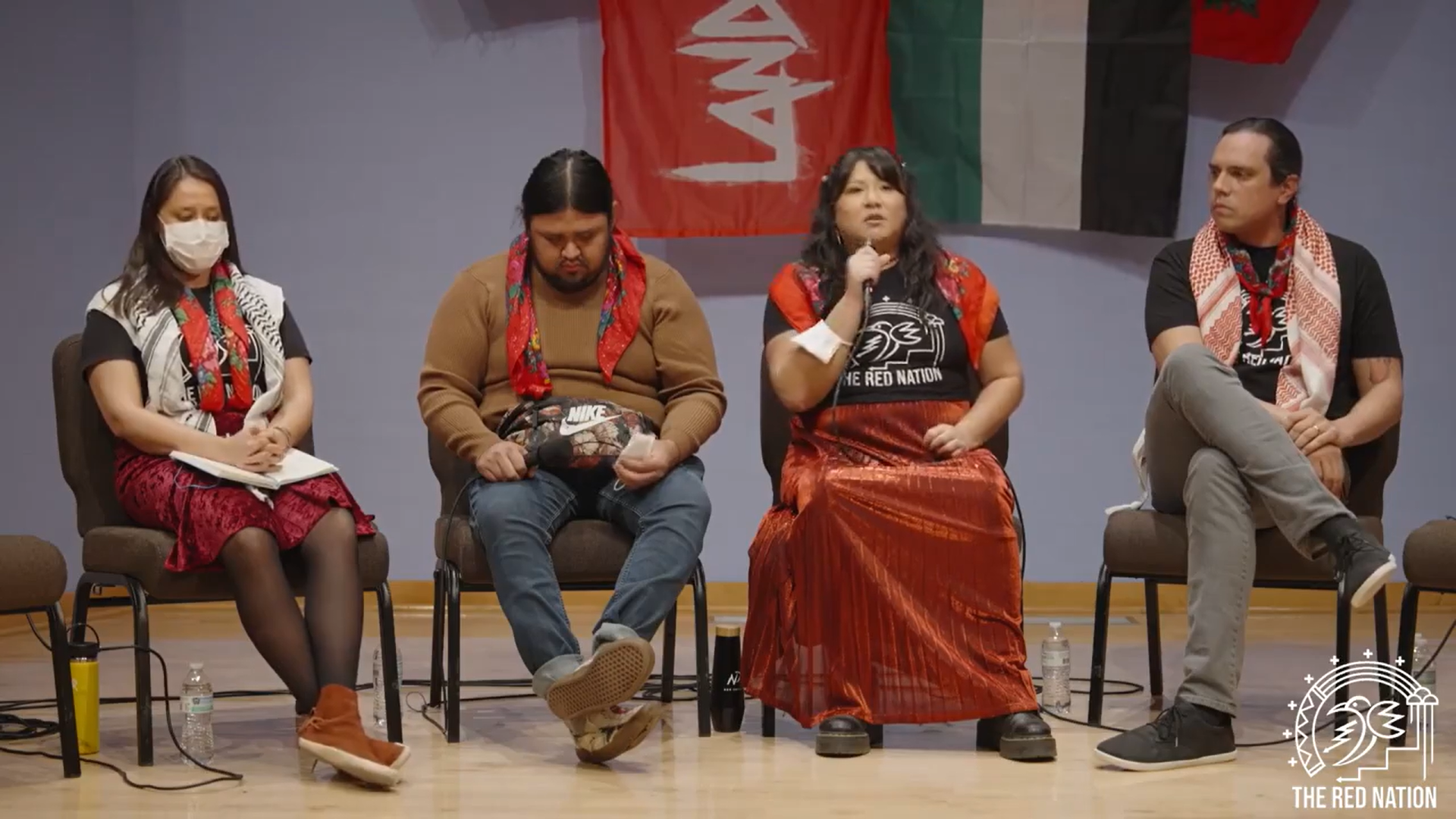
Red Nation hosted From Minnesota to Palestine: Teach In and Panel Discussion on December 3rd.
This Teach-In showed the ties and need for solidarity amongst the AIM, BLM, Stop Cop City, and other movements. Two University of Minnesota Twin Cities professors led this teach-in. 🧵 pic.twitter.com/dgaUR5dXlR
— Stu Smith (@thestustustudio) December 13, 2023
The ideology driving these actions draws straight from Mao’s revolutionary warfare doctrine which details underground political organization, guerrilla warfare operations, and collectivist ideological frameworks of struggle—viewing war as a continuation of politics by other means.
Prosecutors, quoting the defendants’ ideological rhetoric, called it a “blend of communist and anarchist views.”
The indictment, quoting defendant Kennedy’s rejection of liberals and non-violence, emphasized the violent approach.
“YOU WILL NEVER WIN WITH NON-VIOLENCE ALONE! You absolutely need militants to win,” Kennedy wrote.
Kennedy, who’s also quoted as saying the burning of the Third Precinct police station was “the happiest moment of my life,” congratulated Oregon ANTIFA for “breaking enough sh*t to actually shut down the federal building.” Adding “Ya, F$%& these dumb F%&# pacifists.”
🚨 Sunrise Movement activist runs the Charlie Kirk vs. Renee Good grief contest at vigil, says “they can shoot us in the face,” then urges street action
This is a Sunrise activist at a so-called “rapid response vigil” in Portland, and the “argument” is just one giant non… pic.twitter.com/ZdH4CbrkuN
— Stu Smith (@thestustustudio) January 9, 2026
Groups like the Black Cat Workers Collective, the Sunrise Movement, and Minnesota 50501 – named as affinity groups – quickly shared the rapid response training tactics, while promoting “community self-defense,” as the struggle to overthrow authority.
🧵 DSA says its Red Rabbits initiative is about “security.” But according to its own authorizing resolution, the project is preparing for a “national uprising against federal agents and police brutality.”
A recent panel showed what that means in practice.
“Takedowns on… pic.twitter.com/5lnZNxlNHA
— Stu Smith (@thestustustudio) June 9, 2026
Subgroups such as the Ray Rainbolt Memorial Shooting Club added “self-defense” training against the “federal occupation,” the “state, and far-right violence more broadly.”
Fifteen defendants, including Kennedy, face charges ranging from conspiracy to impede federal officers to assaults, stalking, and threats.
“As alleged, these defendants, which included members of Antifa groups, engaged in an unrelenting campaign of harassment and violence targeting federal and local law enforcement,” Acting Attorney General Todd Blanche said. “Their actions created a dangerous environment that threatened not only their intended targets, but the community as a whole.”
🚨 Is This Chris Cuomo Surrendering to DSA? Is DSA the Future of the Democratic Party?
This Chris Cuomo segment almost feels like a surrender to the DSA.
Cuomo frames the Democratic Socialists of America as the Democrats’ best shot at capturing populist affordability anger,… pic.twitter.com/qWkL15oo6a
— Stu Smith (@thestustustudio) June 21, 2026
Prosecutors call it an “anarchists’ playbook” exploiting lawful protests for militant ends. Critics call it further proof that Democrats have “surrendered” to a radical and dangerous ideology, now shaping election outcomes.
Following the unsealed indictment, new protests have since erupted. As the trial looms, however, the country will soon find out if the courts draw a firm line between protest and organized obstruction.