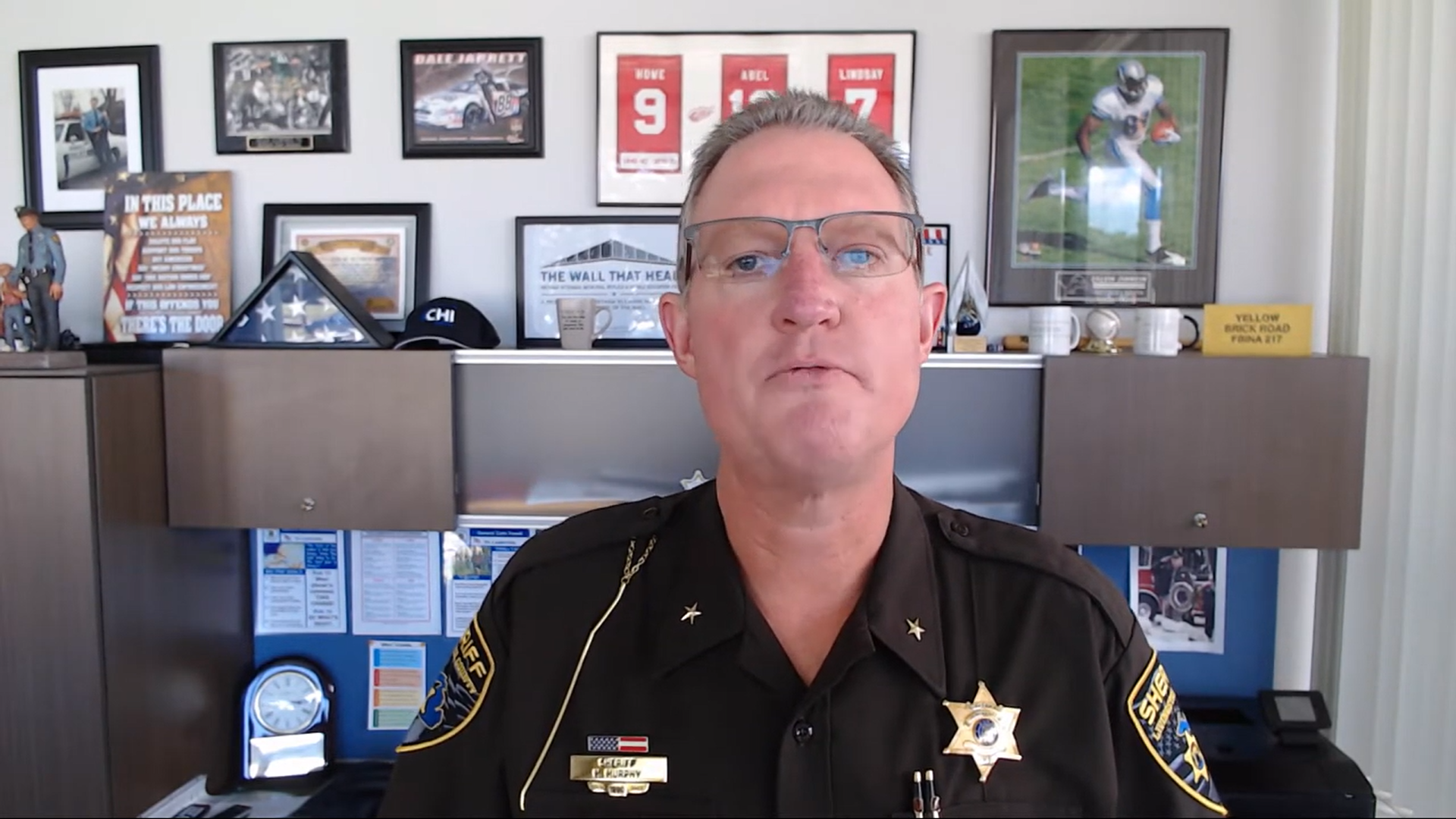
The Livingston County Sheriff’s Office recently formalized an agreement to work with U.S. Customs and Immigration Enforcement, becoming the eighth jurisdiction in Michigan to participate in ICE’s 287(g) program.
Signed on Monday in Livingston County, the agreement is for the Warrant Service Officer model, which “allows designated immigration officers to serve and execute administrative warrants on aliens in their custody,” according to the ICE website.
Livingston County Sheriff Mike Murphy backed the agreement, telling Michigan Advance that the Sheriff’s Office’s participation does not change how his deputies conduct themselves or carry out law enforcement duties.
Murphy, who is also a Republican candidate for state Senate, said his office already cooperated with ICE and other U.S. Department of Homeland Security agencies.
“We have always cooperated with other agencies, whether state, federal, local, doesn’t make any difference,” he said.
Livingston County joins five other counties and two municipalities in the state with an active 287(g) agreement. The other sheriff’s offices participating include Berrian, Calhoun, Crawford, Jackson and Roscommon, along with Taylor Police Department and West Branch Police Department.
Located in southeast Michigan, Livingston County is surrounded by the Democratic strongholds of Detroit, Ann Arbor and Lansing. It’s the state’s 10th-most populous county and includes major highway connections to those cities.
Murphy said his office has always honored detainer requests from ICE and other agencies for individuals held in the Livingston County Jail.
“If another bona fide law enforcement agency says, ‘Hey, please hold this person, because we’ll come get them,’ then by all means, we’re going to hold them. That’s what we do,” Murphy told Michigan Advance. “We have always done that for ICE.”
In nearby Washtenaw County, one of the most liberal counties in Michigan, pansexual Sheriff Alyshia Dyer has refused to cooperate with ICE agents and county officials have battled with the Trump administration over various issues.
The partnerships have faced pushback in many communities, particularly by immigration activists and progressive politicians. It is the second agreement signed this year in Michigan — but the first, signed by the village of Oakley officials in Saginaw County, was rescinded just months later by the Oakley Village City Council.
In sanctuary jurisdictions, state and local politicians create policies that prevent law enforcement agencies from cooperating with ICE or honoring immigration detainers.
ICE’s 287(g) program has expanded under the Trump administration and has three models to assist with immigration enforcement. Through the partnership, local law enforcement agencies have “the authority to perform specified immigration officer functions under ICE’s direction and oversight.”
As of July 20, ICE has signed 2,179 Memorandums of Agreement for 287(g) programs covering 39 states and two U.S. territories, according to the 287(g) webpage.
Murphy said the Warrant Service Officer model allows designated immigration officers to “detain illegals and legitimately serve them with notice that they’re being detained for immigration.”
Sheriff Murphy intentionally steered away from participating in the Task Force Model, which allows for more direct immigration enforcement by local officers.
“There’s a reason that there’s local law enforcement, and there’s a reason that there’s federal law enforcement,” he told Michigan Advance. “We both enforce different laws.”
Some states, including Florida and Georgia, have passed legislation requiring local law enforcement participation, with penalties or funding cuts for sheriffs who refuse to cooperate.
In addition, local law enforcement agencies have access to grants and other funding.
Murphy said the Sheriff’s Office wanted to apply for a new U.S. Department of Justice grant opportunity that can be used for equipment for immigration investigations.
However, only agencies with 287(g) agreements or plans to enter such an agreement are eligible to apply.